Notice!!!
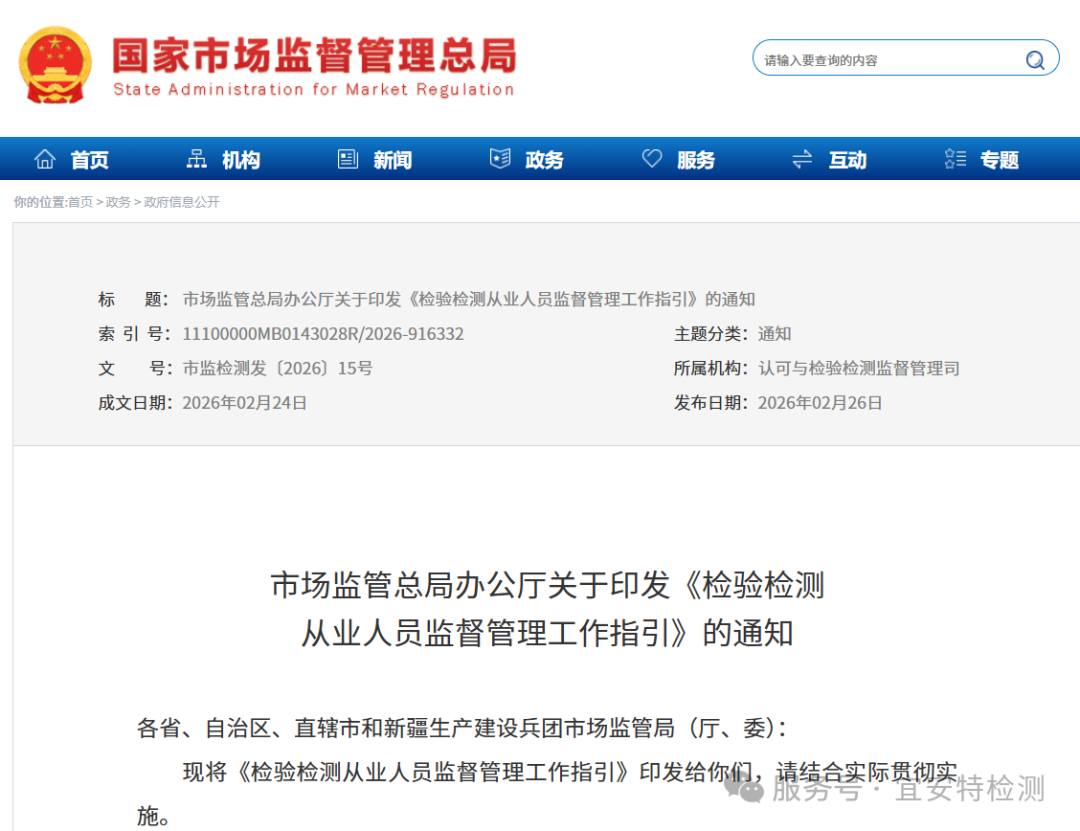
On February 24, 2026, the State Administration for Market Regulation issued the new version of the "Guidelines for Supervision and Management of Inspection and Testing Practitioners"
The core of this new regulation is to implement the principle of "who issues the certificate is responsible; who signs bears the responsibility," completely ending the industry chaos of the past where "institutions are penalized, but personnel continue working by changing positions."
For production enterprises and enterprises with testing needs, this is not only a major reshuffle in the inspection industry but also an important indicator for enterprises to choose inspection partners and standardize their own inspection behaviors—only by selecting compliant inspection institutions and adhering to the bottom line of authentic inspection data can enterprises keep their development away from compliance risks.
Every report and every signature of inspection practitioners will be bound to their careers for life, and behind this, it directly relates to the legal validity of enterprise inspection reports, data authenticity, and even the compliance of enterprise production and operation.
1. "New Rules" That Practitioners and Institutions Must Know
Core Responsibilities of Inspection and Testing Institutions
(1)Shall establish and improve management systems such as practitioner practice file management and information disclosure.
(2)Shall implement whole-process management of practitioners to ensure their capabilities continuously comply with legal requirements and work needs.
(3)Shall not employ personnel prohibited by laws and administrative regulations from engaging in inspection and testing activities.
(4)Shall establish legal labor or employment relationships with practitioners and clarify their job responsibilities and authorization scope through appointment documents, authorization documents, job responsibility statements, etc.
Practitioner Qualification Requirements
(1)The number, structure, education level, professional technical background, work experience, practical operation ability, qualifications, etc., of institutional technical personnel and management personnel (including top management, technical manager, quality manager, authorized signatory, etc.) must comply with laws and regulations, accreditation assessment criteria, and relevant standards and technical specifications.
(2)Practitioners are encouraged to participate in the national professional competency evaluation and vocational skill level certification for inspection and testing management engineering technicians.
Practitioner Code of Conduct
5 Types of Situations That Must Be Refused and Immediately Reported to the Institution
(1)Instructing, directing, or forcing practitioners to issue inspection and testing reports in violation of regulations;
(2)Inspection and testing conditions do not meet requirements, yet still demanding to carry out related work;
(3)Using uncalibrated, unverified, or failed verification equipment to carry out work;
(4)Conducting inspection and testing activities beyond one's own capability scope;
(5)Other situations that violate laws, regulations, and inspection and testing norms.
7 Types of Strictly Prohibited Professional Behaviors
(1)Seeking improper benefits by taking advantage of professional practice;
(2)Instructing, directing, condoning, or covering up others issuing inspection and testing reports in violation of regulations;
(3)Impersonating others or signing inspection and testing reports or related records on behalf of others;
(4)Forging or tampering with inspection and testing data, results, or related records;
(5)Abusing inspection and testing qualifications and credentials;
(6)Engaging in part-time inspection and testing related work across institutions without the consent of one's own institution;
(7)Other illegal, non-compliant behaviors that violate professional ethics.
2. Summary Table of Core Supervision Time Limit Requirements
Furthermore, the new regulations also clarify a series of core supervision time limits, which are important bases for enterprises to judge whether inspection institutions are compliant:
(1)For example, changes in key position personnel of institutions must be reported to the supervision department within 10 working days;
(2)After practitioners are prohibited from practice, they will be entered into the national list within 5 working days;
(3)When the prohibition period expires or the prohibition is lifted early due to legal reasons, the list status will be updated within 5 working days after the expiration or decision is made;
(4)The list must include core content such as personnel identity information, original employing institution, illegal and non-compliant behaviors and penalty basis, prohibition period and start/end dates, penalty authority, etc.
Finally, 3 Core Suggestions for All Enterprises:
(1)Don't choose institutions based solely on low prices; compliance is always more important than saving money;
(2)When selecting institutions, first verify personnel qualifications, reject institutions with certificate hanging or separation of personnel and certificates;
(3)Keep original inspection records throughout the entire process to ensure report traceability.
